



Sentence for Count: Master Writing Structure for Better Readability
2026-08-10 08:02:14
Every word you write either advances your message or clutters it. When writers focus on "sentence for count"—meaning deliberate counting of sentences to optimize structure—they unlock a strategic advantage. This approach transforms writing from intuitive guessing into data-driven refinement.
Understanding Sentence Structure Through Counting
"Sentence for count" represents the practice of counting sentences strategically to evaluate and improve how you communicate. Rather than writing first and fixing later, intentional writers use counting as a real-time guide during composition.
When you count sentences deliberately, you become aware of patterns. Maybe you discover that you write 30 complex sentences followed by three simple ones, creating reader fatigue before the payoff. Or perhaps you realize that every single sentence runs 25+ words, leaving no breathing room. These patterns are invisible until you count.
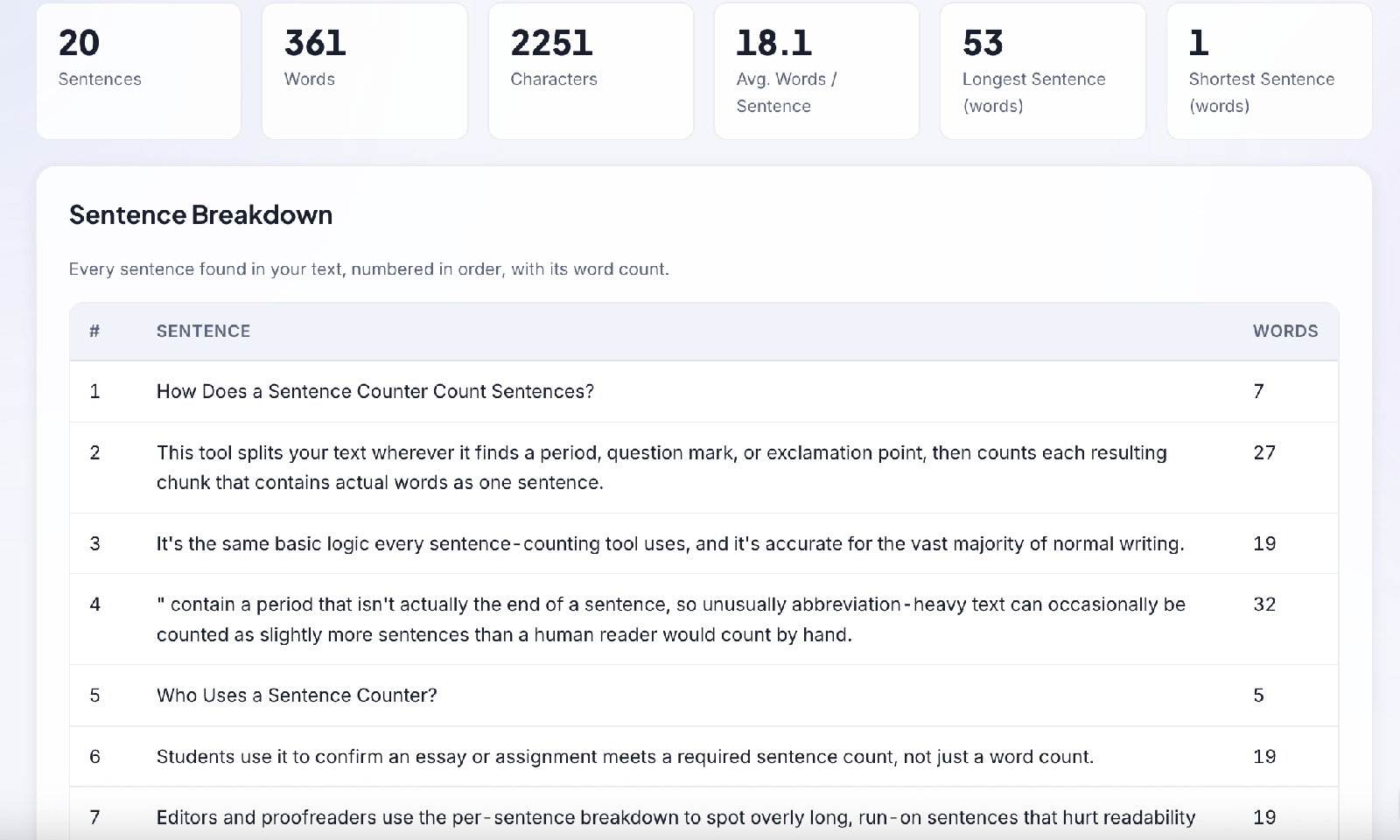
A sentence counting tool at SEOWebToolkits makes this awareness instant and objective. Rather than gut feeling, you get metrics. Rather than assuming your writing flows well, you measure it.
Why Professional Writers Count Sentences
Professionals across industries have discovered that sentence counting improves outcomes:
- Journalists discovered that readers prefer articles with average sentence length under 20 words. News organizations train writers to count sentences because studies prove shorter sentences increase comprehension and sharing.
- Marketing Copywriters realized that product pages converting at 3% become 5% converters when they reduce average sentence length from 22 to 16 words.
- Academic Authors learned that editors reject papers with inconsistent sentence length, even when content is sound.
- SEO Specialists discovered that Google's search algorithm rewards content with sentence variety. Pages with varied sentence lengths rank better.
Counting forces you to see your writing through readers' eyes. A wall of long sentences feels exhausting. A series of choppy short sentences feels juvenile. The ideal is balance—and balance requires counting.
Optimal Sentence Counts for Different Content Types
Different writing contexts have different sentence-count targets:
- Blog Posts: Aim for 15-20 words per sentence average. A 1,500-word blog post should contain 75-100 sentences.
- Marketing Copy: Keep sentences under 15 words average. Landing pages and product descriptions need even tighter control.
- Email Campaigns: Professional emails average 12-15 words per sentence. Subject lines should be single sentences under 50 characters.
- Academic Papers: Tolerance extends to 20-25 words per sentence, but variety remains essential.
- Social Media: Tweets work best as single sentences. LinkedIn posts can use 2-3 sentences per paragraph.
- Technical Documentation: Aim for 15-18 words per sentence because complex terminology demands shorter structures.
These aren't rigid rules—they're guidelines based on how human brains process text. Using a free sentence counter lets you verify that your content matches your intended audience's expectations.
Sentence Counting Strategies for Improvement
- Strategy 1: The Baseline Audit - Paste a recent piece of writing into a sentence counter and record: Total sentences, Total words, Average sentence length, Longest sentence, Shortest sentence. This baseline reveals your natural writing style.
- Strategy 2: The Variety Test - Look at your sentence length distribution. Aim for roughly: 30% short sentences (under 15 words), 50% medium sentences (15-25 words), 20% long sentences (over 25 words).
- Strategy 3: The Targeted Revision - Once you identify problem areas, revise strategically. Break longer sentences, combine choppy short sentences, insert short sentences to break monotony.
How Sentence Counting Improves SEO
Search engines don't directly measure sentence count, but they measure readability—and readability depends on sentence metrics. Google's ranking algorithms favor content that maintains reader engagement, presents information scannably, and achieves high reading comprehension.
When you use SEOWebToolkits to count and optimize sentences, you're indirectly optimizing for search engines. Better readability metrics translate into better user signals, which influence rankings. Content with 80-100 sentences per 1,000 words typically outranks content with 40-50 sentences per 1,000 words in competitive niches.
Combining Sentence Counting with Other Writing Tools
Sentence counting works best alongside other writing analysis: Sentence Counter + Word Counter = Volume and structure combined. Sentence Counter + Character Counter = Perfect control for character-limited platforms. Sentence Counter + Readability Checker = Comprehensive writing quality assessment.
Common Mistakes in Sentence Structure
- Mistake 1: Sentence Monotony - Using consistently identical sentence length creates reader boredom. Counting reveals this immediately.
- Mistake 2: Dense Paragraphs - Paragraphs with 5-7 equally long sentences intimidate readers. Vary sentence length.
- Mistake 3: Buried Key Information - Putting crucial information midway through long sentences reduces impact.
- Mistake 4: Repetitive Openings - Starting multiple sentences identically creates monotony.
Conclusion
"Sentence for count" isn't just academic exercise—it's a professional writing technique that improves every type of communication. When you count sentences deliberately, you shift from intuitive writing to intentional writing. You replace guessing with measurement.
Start today by pasting your next piece into a free sentence counter at SEOWebToolkits. Measure your baseline. Then consciously revise toward the optimal range for your content type. Professional writers don't leave sentence structure to chance. They count, analyze, and optimize.
Reviews
Log in to write a review.
No written reviews yet - be the first to share your thoughts.